SENS-PHOS
SENS-PHOS

Team: Connie Jimenez, Nina Fransen, Adriaan Bins, Bart Westerman
Cancer and dementias are aging-associated diseases characterized by aberrant cell growth and cell death. Altered protein phosphorylation and signaling has been implicated in both malignant and neurodegenerative diseases. More specifically, brain Fronto-Temporal Lobe Dementia will be studied and a P-proteomics profile of disease progression trajectory will be made.
All malignant disease is characterized by hyperactive growth and survival signaling catalyzed by oncogenic kinase activity. Therefore over 30 kinase inhibitors have been developed and approved as anti-cancer agents for clinical use. Moreover, pathway activity revealed by (phosphor)proteomics is also relevant in the immunotherapy context and cellular cross-talk.
We hypothesize that FTD and different cancers may exhibit distinct alterations in signaling pathways and phosphorylation patterns that may provide the basis for improved understanding of cell vulnerability and resilience (dementia) and treatment selection (cancer).
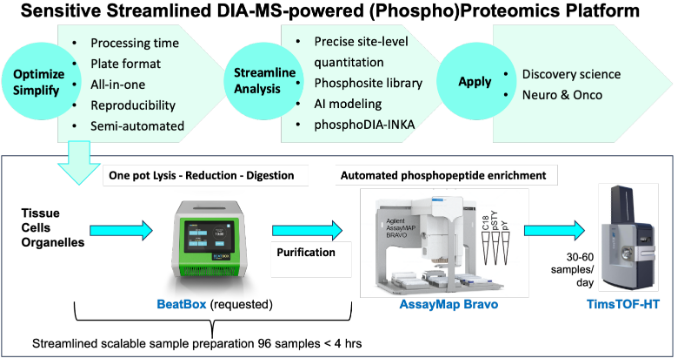
To unlock cell (co)culture and tissue proteome and phosphoproteome for mechanistic insights on cell-cell crosstalk, biomarker and target discovery, an unbiased approach is needed that can enable large scale, sensitive analysis of biological and clinical materials. To this end, streamlining sample preparation to minimize sample losses and variability, in conjunction with DIA-MS-based phosphoproteomics for in-depth kinase and pathway activity analysis is required.
The first objective of this project is to develop a miniaturized phosphoproteomics workflow that is compatible with small cell co-culture and (microdissected) tissue samples, that is scalable, robust, and reproducible. To this end, a one-tube core processing method will be implemented with processing time for 96 samples reduced to < 4-8 hours. On the mass spectrometry side of the proteomics workflow, in recent years, data-independent mass spectrometry has emerged as a powerful clinical proteomics approach that combines the benefits of global analysis with the quantitative precision of targeted MS. However, phosphosite quantitation in DIA-MS data can be significantly improved when reference phosphosites are available with consistent site-level reporting to serve as input forkinase and pathway activity analysis.
Therefore, a second objective of this project is to develop a landscape of phosphosites from existing datasets in neurological disease and cancer studies and adapt our previously developed integrative kinase activity analysis pipeline (INKA, www.inkascore.org) to phosphoDIA data.
Finally, to address the needs in the Cancer-Neuroscience field, a third objective is to apply the developed platform to the analysis of complex co-culture systems as well as archival brain and tumor samples and unravel altered kinase signaling and pathway activities in cell-cell communication under physiological conditions and disease states, in relation to therapy response.