CAR-TB-EXPLORE
CAR-TB-EXPLORE

Team: Joost Raaphorst, Marie José Kersten
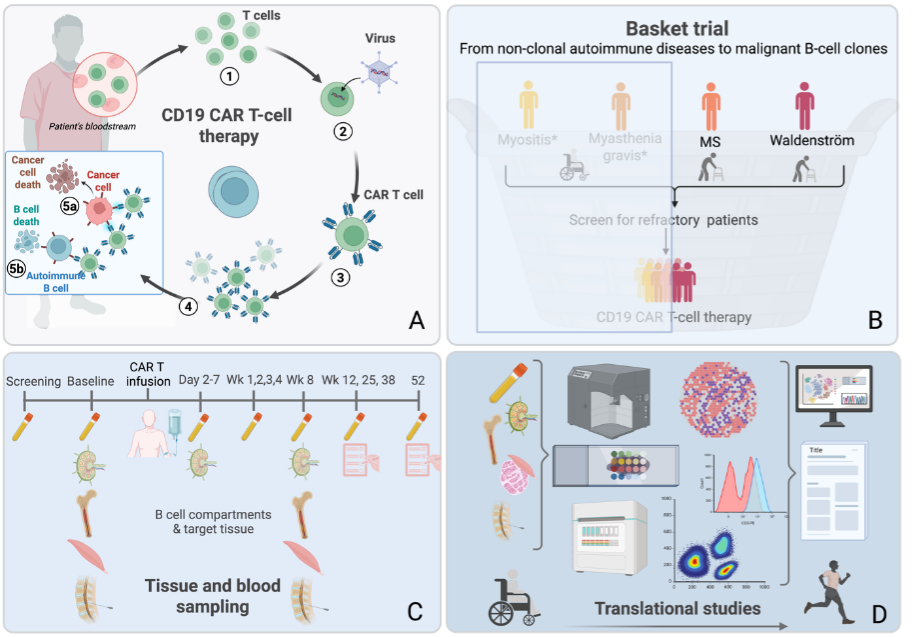
CD19-targeted CAR T-cell therapy has revolutionized the treatment of B-cell malignancies, inducing long-term remissions in patients with various lymphomas. Its application in rare B-cell malignancies, and in B-cell–driven autoimmune diseases remains largely unexplored. Interestingly, there are clear differences in CAR T-cell persistence and B-cell depletion in autoimmune diseases (AID) versus patients with B-cell malignancies, with significantly shorter duration of B-cell depletion in AID. The mechanisms underlying these differences are not well understood.1 It remains unclear whether limited persistence is driven by intrinsic features of patient’s T-cell, or CAR T-cell repertoire, by disease-specific factors, or by host immune regulatory mechanisms. The deep B-cell depletion and lack of recurrence of autoreactive B-cells seems to imply an incompletely understood deep immunological reset. To address these questions, we will perform a comprehensive analysis of (CAR) T-cell phenotype, function, and metabolic fitness, both in the apheresis material, the final CAR T-product, and longitudinally post-infusion in peripheral blood samples. Single-cell spatial transcriptomics and interactome analyses of early post-infusion biopsies have demonstrated that cell-cell interaction networks between CAR T-cells and the tissue microenvironment emerge within days of infusion and associate with clinical outcomes, establishing early tissue profiling as essential for understanding factors governing CAR T-cell expansion, dysfunction, and persistence.2 By using the same academic CAR T-cell product across diverse patient groups this study will uniquely reveal the factors driving CAR T-cell persistence in both malignant and autoimmune contexts. The results will guide the rational design and optimization of CAR T-cell therapy for rare B-cell malignancies and B-cell–mediated AID.
We aim to treat 10 patients with autologous CD19 CAR T-cell therapy and perform pre- and post-treatment multicompartmental sampling, which is carefully aligned between CAR T studies, enabling disease overarching comparisons. We will comprehensively profile infused CAR T-cells before and after administration to assess: (1) expansion kinetics and contraction; (2) memory subset distribution; (3) activation and exhaustion marker expression; (4) metabolic fitness and mitochondrial function; and (5) in vitro cytotoxicity. These analyses will identify phenotypic and functional features associated with expansion, persistence duration, and clinical efficacy.
We will study dynamics, in both functional and structural contexts of T and B cells and other key immune cells. Sampling includes lymph nodes, bone marrow, target tissue and blood. State-of-the art spectral flow immunophenotyping of lymphocytes, single cell/spatial transcriptomics and cell proteomics may elucidate how B-cell eradication affects auto-reactive B cell clones, follicular dendritic cell networks and T-cells including both effector T-cells and regulatory T-cells.
References:
1. Tur C, Eckstein M, Velden J, et al. CD19-CAR T-cell therapy induces deep tissue depletion of B cells. Ann Rheum Dis 2025; 84(1): 106–14.
2. Mo KC, Kramer AM, Yeh CY, Good Z. CCL8+ CCL13+ tumor-associated macrophages mark early resistance to CAR T cell therapy in large B cell lymphoma. Available at SSRN 5778444. Cancel Cell; CELL-D-25-01576, Available at SSRN: https://ssrn.com/abstract=5778444