ORBIT
ORBIT

Team: Ruud Wijdeven, Victor van Beusechem, Bart Westerman, Iwan de Esch
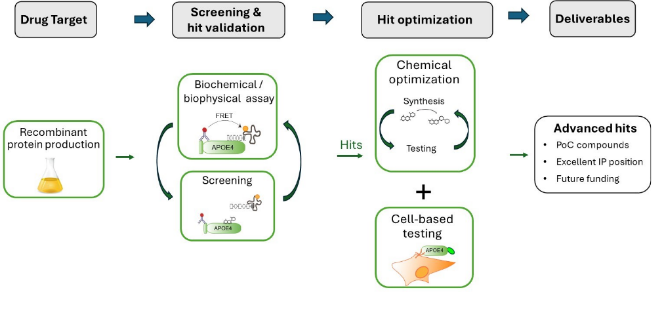
Protein–protein interactions (PPIs) are central to every cellular process and constitute the largest and least explored drug target class. Because protein interaction surfaces are larger and differently organized than enzyme active sites, multiple screening approaches are needed to identify potent inhibitors. We will therefore establish three complementary methods: DNA-encoded library screening, Fragment-Based Drug Discovery (FBDD), and computer-aided drug design. These modular technologies enable parallel screening strategies and multiplexing of targets. Depending on the target and desired molecule, the most suitable approach will be selected. Our strategy aims to identify hit molecules with strong clinical translation potential by blocking APOE uptake in Alzheimer’s disease, inhibiting the spliceosome in lung cancer, or specifically degrading MCL1 in tumor cells.
Research at Amsterdam UMC has identified three promising drug targets for which protein-interaction modulators have major therapeutic potential: one for Alzheimer’s disease and two for cancer.
APOE is the strongest genetic risk factor for Alzheimer’s disease, with 40–50% of patients carrying at least one APOE4 allele. Unlike the protective APOE2 and APOE Christchurch variants, APOE4 promotes lipid accumulation through increased cellular uptake.1,2 Blocking APOE uptake may therefore convert its toxic effects into a protective phenotype. Uptake is mediated by lipid receptors together with heparan sulfate proteoglycans (HSPGs). Genetic data from Amsterdam UMC show that enzymes modifying HSPGs to enable APOE binding are also linked to Alzheimer’s disease, highlighting the importance of this pathway. Our goal is to develop small molecules that disrupt the HSPG–APOE interaction and thereby prevent cellular uptake of toxic APOE4.
The spliceosome, a dynamic complex of proteins and small nuclear RNAs, is essential for mRNA splicing. Cancer cells are more sensitive than normal cells to spliceosome disruption, making it an attractive therapeutic target. We identified Sm proteins at the spliceosome core as novel targets.3,4 Patient-derived lung cancer organoids are sensitive to Sm gene silencing, whereas normal airway organoids remain unaffected. Since Sm proteins form a heptameric ring, we aim to disrupt the interaction between adjacent Sm proteins, particularly SmD1 and SmD2, to inhibit spliceosome function.
Glioblastoma is highly sensitive to inhibition of the anti-apoptotic protein MCL1, but direct MCL1 inhibitors cause cardiac toxicity.5,6 Instead, we aim to selectively degrade MCL1 using PROTAC technology, which recruits an E3 ubiquitin ligase to induce target degradation. Because glioblastoma frequently amplifies the E3 ligase MDM2, a key tumor driver, we will develop an oncoPROTAC strategy linking MCL1 to MDM2, enabling selective MCL1 degradation in cancer cells.
References
1. J. F. Arboleda-Velasquez et al., Resistance to autosomal dominant Alzheimer’s disease in an APOE3 Christchurch homozygote: a case report. Nat Med 25, 1680-1683 (2019).
2. J. L. Guo et al., Decreased lipidated ApoE-receptor interactions confer protection against pathogenicity of ApoE and its lipid cargoes in lysosomes. Cell 188, 187-206.e126 (2025).
3. M. Blijlevens, I. H. van der Meulen-Muileman, R. X. de Menezes, E. F. Smit, V. W. van Beusechem, High-throughput RNAi screening reveals cancer-selective lethal targets in the RNA spliceosome. Oncogene 38, 4142-4153 (2019).
4. J. Li et al., Evaluation of Spliceosome Protein SmD2 as a Potential Target for Cancer Therapy. Int J Mol Sci 25, (2024).
5. M. Houweling et al., Screening of predicted synergistic multi-target therapies in glioblastoma identifies new treatment strategies. Neurooncol Adv 5, vdad073 (2023).
6. S. Shyam Sunder, U. C. Sharma, S. Pokharel, Adverse effects of tyrosine kinase inhibitors in cancer therapy: pathophysiology, mechanisms and clinical management. Signal Transduct Target Ther 8, 262 (2023).