CRISPR – Proof of Concept
CRISPR – Proof of Concept

Team: Thom Molenaar, Job de Lange
Combinatorial CRISPR screening is a method used to identify two genes that, when depleted simultaneously, cause a specific phenotype. In cancer drug discovery, this is a powerful approach for identifying synthetic lethal interactions. Synthetic lethality occurs when the loss of function of either gene alone has little effect, but the combined loss of both genes leads to cell death. This concept is highly valuable for cancer therapy, because it enables the selective killing of tumor cells that have already lost a tumor suppressor gene, while sparing healthy cells. Combinatorial CRISPR screening can also be used to discover combinations of drug target genes that are synthetic lethal with the loss of a tumor suppressor gene, paving the way for more precise and effective treatment strategies.
In a mirrored but opposite fashion, combinatorial screening is also a powerful way to identify genes that when depleted simultaneously rescue viability in protein aggregation models for neurodegenerative diseases. A current caveat with combinatorial CRISPR screening is the massive sequence space required for screening a large amount of combinations.
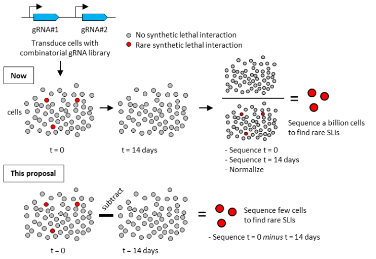
Here we propose a straightforward method that drastically reduces the amount of sequence space required for combinatorial screening by essentially subtracting non-synthetic interactions from the screening pool before sequencing (Figure 1). This will enable combinatorial CRISPR screening using many more gene combinations than is currently practical.
Our aim is to provide a proof-of-concept (PoC) in a 1-year project for a new combinatorial CRISPR screening method that allows us to drastically upscale the amount of genes that can be screened in combination. In this PoC study, we will focus on using cancer cells to test and validate this new method using known combinations of synthetic lethal genes. If this PoC phase is successful, we will apply this new method in follow-up project to identify synthetic lethal interactions in cancer, and a simplified, non-combinatorial version of this methodwill be applied to advance CRISPR screening in neurons derived from iPSCs to identify synthetic viable interactions in protein aggregation models for neurodegenerative diseases. This project therefore serves as a starting point to advance CRISPR screening with the ultimate aim to exploit weaknesses in cancer cells and develop novel therapies for neurodegenerative diseases.